Beginner Tips for Queens Logic Puzzles
Practical Queens puzzle strategies for solving more boards with elimination, forced cells, line locks, and careful contradiction checks.
playqueensgame
7. Mai 2026
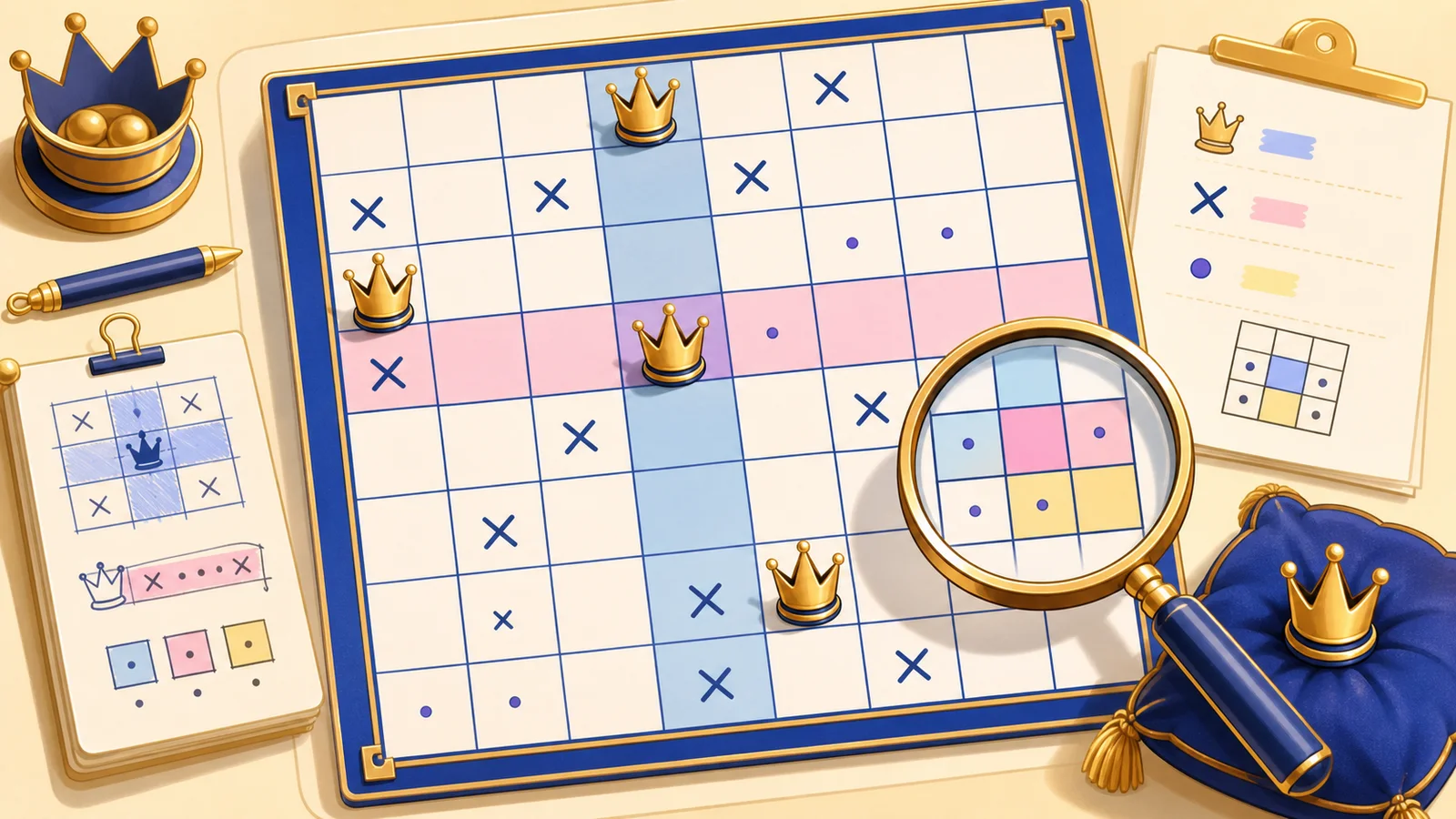
Practical Queens puzzle strategies for solving more boards with elimination, forced cells, line locks, and careful contradiction checks.
Queens puzzles get much easier when you stop looking for the answer and start removing what cannot be true. The rules give you four sources of pressure: rows, columns, colored regions, and no-touch adjacency. Good solving comes from combining those pressures cleanly.
The tips below are aimed at beginners who know the rules but still feel stuck after the first obvious moves. Use them in order. The early techniques are cheap and reliable; the later ones are for boards that stop moving.
A Beginner Solving Workflow
- Do an impossibility scan. Before placing a queen, mark cells that are already ruled out by visible row, column, region, or touching constraints.
- Check small regions. Tight regions often produce the first useful deduction because they have fewer legal cells.
- Place forced queens. If a row, column, or region has only one legal cell left, that queen is forced.
- Clean up immediately. After every queen, mark the rest of its row, column, region, and all touching cells.
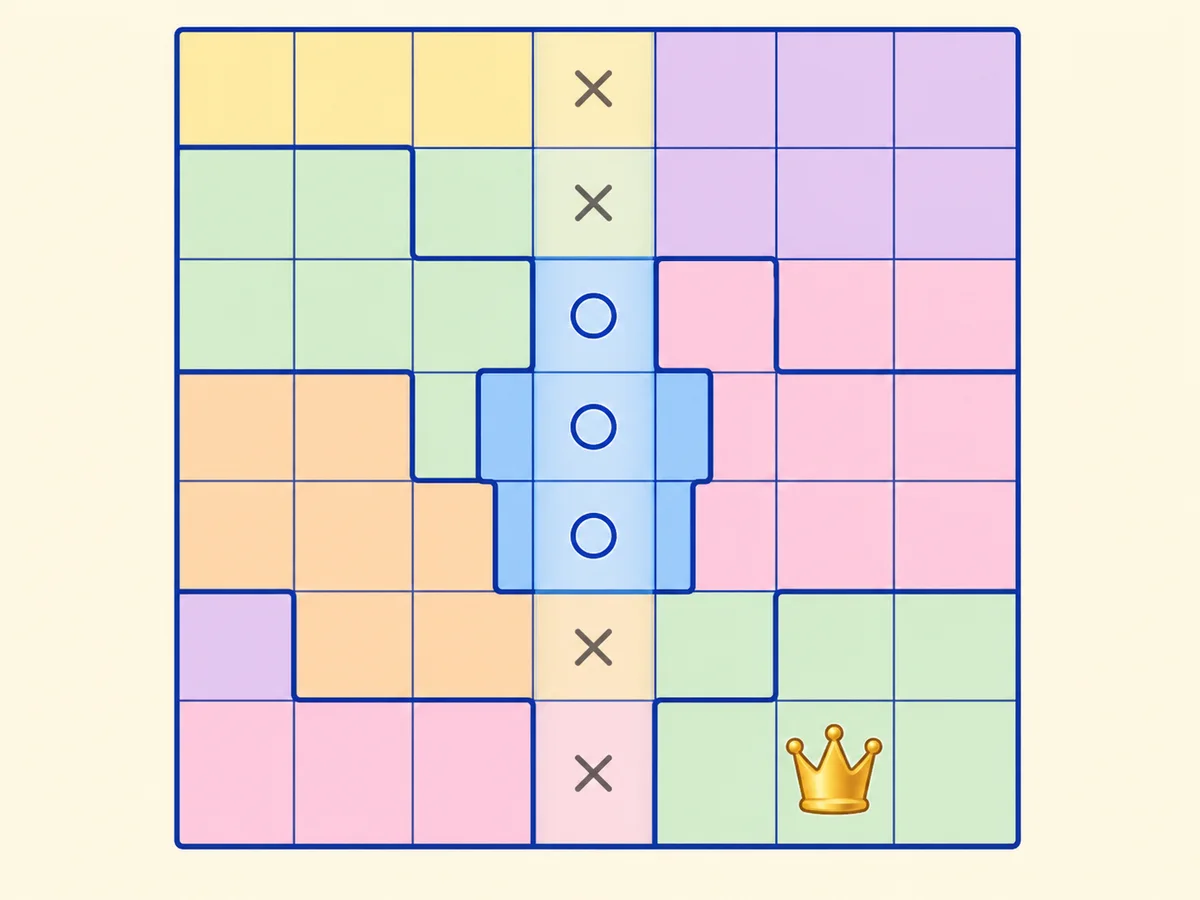
- Look for line pressure. If all candidates for a region sit in one row or one column, that line is claimed.
- Use group pressure. If two regions are trapped in the same two rows, those rows are reserved for those regions. The same idea works with columns.
- Test only when needed. If nothing else moves, test a tight candidate and look for a contradiction.
1. Mark Impossible Cells First
When to use it: At the start of the board and after every queen.
Why it works: Queens is an elimination puzzle. You usually make progress by removing bad cells faster than by spotting good cells. X marks reduce mental load and reveal forced placements.
Example: If a queen is placed in row 3, column 5, do not move on. Mark the rest of row 3, the rest of column 5, the other cells in that queen's region, and every touching neighbor. That cleanup may reduce a nearby region to one legal cell.
2. Look for Forced Cells
When to use it: After every cleanup pass.
Why it works: A row, column, or region with one legal cell left has no choice. That placement is not a guess.
Example: A yellow region has three empty cells, but two are blocked by existing row and touching constraints. The third cell must contain the yellow queen.
3. Scan the Smallest or Strangest Regions
When to use it: Early in the puzzle, before many queens are placed.
Why it works: Small regions and awkward shapes leave fewer arrangements. Even when they do not give a queen immediately, they often confine a region to one row or column.
Example: A three-cell L-shaped region may have one cell that would force all nearby options into blocked positions. Removing that one bad cell can create a line lock.
4. Use Row and Column Pressure
When to use it: When a region has several candidates, but all of them sit in the same row or column.
Why it works: If a region's queen must be somewhere in row 6, then row 6 is already reserved for that region. No other region can place its queen in row 6.
Example: A blue region has three candidates left and all three are in column 2. You do not know which blue cell is correct, but every non-blue candidate in column 2 is impossible.
5. Extend Line Pressure to Groups
When to use it: When two regions are confined to the same two rows or columns, or three regions are confined to the same three rows or columns.
Why it works: The number of reserved lines matches the number of regions that must use them. Other regions cannot enter those lines.
Example: Two unfinished regions each need a queen, and all their candidates lie in rows 7 and 8. Those two rows are already spoken for by those two regions. Mark candidates from other regions in rows 7 and 8.
6. Use the No-Touch Rule Harder
When to use it: Around corners, region borders, and dense clusters of candidates.
Why it works: A queen blocks neighboring cells, including diagonal neighbors. Any 2 by 2 cluster can contain at most one queen because every cell in that cluster touches the others directly or diagonally.
Example: A region has two candidates, and both would touch the same outside cell. That outside cell can never be a queen, no matter which candidate wins inside the region.
7. Count Legal Cells Instead of Guessing
When to use it: Whenever the board looks visually messy.
Why it works: Good solvers are usually not seeing magic patterns. They are counting remaining legal cells against remaining requirements: one queen per row, one per column, one per region.
Example: Column 9 may look open, but after region ownership and adjacency are considered, only one cell may still be legal. That cell is forced even if the column did not look special at first glance.
8. Use Contradiction Checks Carefully
When to use it: Only after marking, forced cells, line locks, and group locks stop producing progress.
Why it works: A controlled test is a proof technique, not a blind guess. Assume one tight candidate is a queen, apply the consequences, and ask whether any row, column, or region is left with zero legal cells.
Example: A red region has two candidates. If testing the upper candidate leaves the green region with no legal cells, the upper red candidate is impossible. The other red candidate is forced.
Common Mistakes and Fixes
Mistake: Placing queens too early
Fix: Do a pure marking pass. If you cannot explain why a queen must be in a cell, leave it unplaced for now.
Mistake: Checking only one rule at a time
Fix: For every candidate, check row, column, region, and touching constraints together.
Mistake: Forgetting diagonal touching
Fix: After every queen, deliberately mark the four diagonal neighbors before scanning elsewhere.
Mistake: Not rescanning after a deduction
Fix: Treat every new X as information. One mark can create a forced queen on the other side of the board.
Mistake: Treating contradiction checks as vibes
Fix: A contradiction must be concrete: a row, column, or region with no legal cell left.
A Simple Practice Plan
For your next few boards, ignore speed. Your goal is cleaner thinking.
- Before placing the first queen, mark at least three impossible cells.
- After every queen, say the cleanup list: row, column, region, touching cells.
- When stuck, scan only for line locks for one full pass.
- Use contradiction checks only on regions with two candidates left.
- At the end, audit every row, column, region, and touching pair.
FAQ
What is the best first habit for a new Queens player?
Use X marks aggressively. They make hidden constraints visible and keep you from revisiting impossible cells.
What should I do when nothing looks forced?
Switch from placement mode to pressure mode. Look for regions confined to one row or column, then for groups of regions confined to the same small set of rows or columns.
Are small boards useful practice?
Yes. Small boards teach the same habits with less noise. Larger boards add longer chains, but the core logic does not change.
Do I need advanced math?
No. The core reasoning is counting and exclusion: one queen per row, one per column, one per region, and no touching.
How do I know I am improving?
You will place fewer speculative queens, make more progress with marks alone, and spot line locks before the board feels stuck.
Related Guides
How to Play Queens Game
Learn the modern Queens Game rules, avoid the diagonal-rule trap, and solve your first board with a simple beginner workflow.
Queens Game Rules Explained
A precise guide to modern Queens Game rules, including rows, columns, color regions, no-touch placement, and the key difference from N-Queens.