How to Play Queens Game
Learn the modern Queens Game rules, avoid the diagonal-rule trap, and solve your first board with a simple beginner workflow.
playqueensgame
7 maggio 2026
Learn the modern Queens Game rules, avoid the diagonal-rule trap, and solve your first board with a simple beginner workflow.
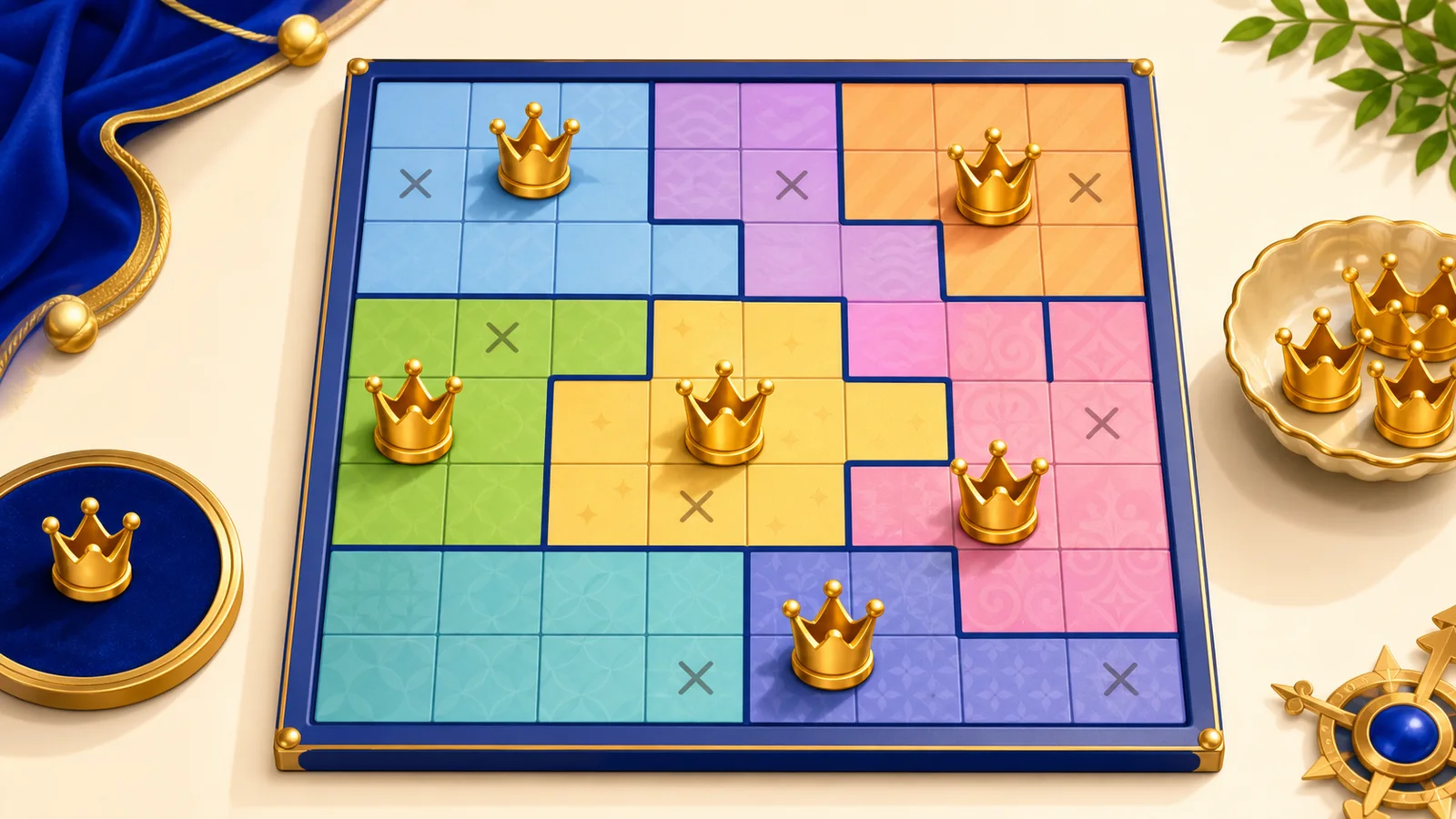
Queens Game is a colorful logic puzzle about placement, not chess tactics. Your job is to place queens on the grid so that every row, every column, and every colored region gets exactly one queen. The extra twist is local spacing: queens cannot touch each other, including diagonally.
That small rule set is why the game is easy to start and still satisfying to solve. You do not need chess knowledge. You need to read the board, mark cells that cannot work, and let one confirmed move create the next deduction.
The Four Rules
Use these four rules every time you look at a Queens board:
- Each row must contain exactly one queen. Once a row has a queen, every other cell in that row is impossible.
- Each column must contain exactly one queen. Once a column has a queen, every other cell in that column is impossible.
- Each colored region must contain exactly one queen. Region color matters as much as row and column position.
- Queens cannot touch. Two queens may not sit in neighboring cells that share a side or a corner.
The last rule is the one new players most often misread. In classic chess, a queen attacks across an entire diagonal. In modern Queens Game, that is not the rule. A queen blocks the adjacent diagonal cells around it, but another queen several squares away on the same diagonal can still be legal if it does not touch.
How to Start Your First Board
Do not start by guessing where a queen looks nice. Start by shrinking the board.
First, scan for the smallest or tightest colored regions. A region with only one legal cell is a forced queen. If no region is forced yet, look for a region whose remaining cells all sit in one row or one column. That row or column is already claimed by that region, even if you do not know the exact square yet.
Second, use X marks aggressively. An X is not decoration. It is your memory outside your head. After each queen, mark every cell ruled out by the row, column, region, and no-touch rules. Many beginner boards become clear only after this cleanup is done.
Third, rescan after every mark. A single X can turn a region from "three possible cells" into "one forced cell." Treat every elimination as real progress.
A Small Worked Example
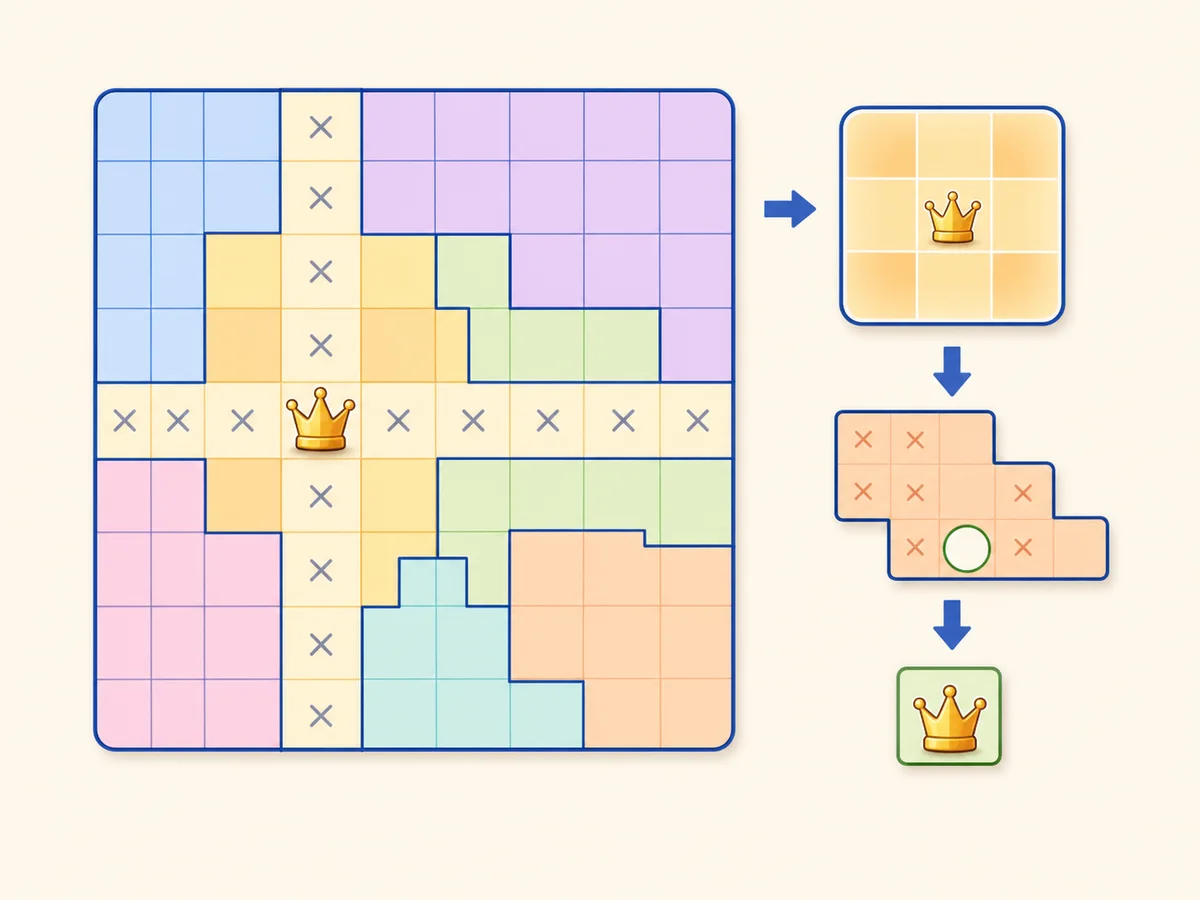
Imagine a 5 by 5 board. The yellow region has been narrowed to one legal cell: row 1, column 3. Place a queen there.
Now do the automatic cleanup. Mark the rest of row 1, because that row already has its queen. Mark the rest of column 3, because that column already has its queen. Mark the other yellow cells, because yellow already has its queen. Then mark the touching cells around row 1, column 3, including the diagonal neighbors below it.
After that cleanup, suppose the green region has two legal cells left and both are in column 5. You still do not know which green cell is correct, but you do know column 5 must hold the green queen. Any non-green candidate in column 5 can be marked impossible. That may leave another row with only one legal cell, which becomes the next queen.
This is the rhythm of Queens Game: forced move, cleanup, rescan, new forced move. You are not searching for a magic square. You are building a chain of small certainties.
Common Beginner Mistakes
Using the wrong diagonal rule
Modern Queens Game does not ban queens from sharing a long diagonal. It only bans queens from touching diagonally. If you apply the classic N-Queens rule, you will reject legal placements and make boards look broken.
Placing a queen without cleanup
A queen placement is only half a move. The cleanup is what exposes the next deduction. If you do not mark the row, column, region, and touching cells, the board keeps fake options alive.
Treating regions as decoration
Colored regions are not background art. A row can look open while a region is nearly solved. Many early deductions come from region shape, especially small, narrow, or awkward regions.
Guessing too early
If you cannot explain why a queen must go in a cell, pause. Look for singles, claimed rows or columns, and region pressure before testing a candidate.
Quick-Start Checklist
- Scan small and tight colored regions first.
- Place a queen only when a row, column, or region forces it.
- After every queen, mark the rest of its row and column.
- Mark the rest of its colored region.
- Mark every touching neighbor, including diagonal neighbors.
- Look for regions trapped inside one row or one column.
- When stuck, stop placing queens and do a pure marking pass.
FAQ
What counts as touching?
Two queens touch if their cells share a side or a corner. Side-by-side contact is illegal, and corner-to-corner diagonal contact is illegal.
Can two queens share a long diagonal?
Yes, as long as they are not adjacent diagonally. This is the biggest difference between Queens Game and classic N-Queens.
Is Queens Game more like Sudoku or chess?
For solving, it is closer to Sudoku. Rows, columns, and regions all constrain each other. The queen icon is theme; the logic is placement and elimination.
Should I use X marks?
Yes. X marks keep the board readable and prevent you from holding too many exclusions in memory.
What should I do when I get stuck?
Rescan for forced cells, then for regions confined to one row or column. If nothing moves, test a tight candidate and see whether it makes a row, column, or region impossible.
Related Guides
Queens Game Rules Explained
A precise guide to modern Queens Game rules, including rows, columns, color regions, no-touch placement, and the key difference from N-Queens.
Beginner Tips for Queens Logic Puzzles
Practical Queens puzzle strategies for solving more boards with elimination, forced cells, line locks, and careful contradiction checks.