Queens Game Rules Explained
A precise guide to modern Queens Game rules, including rows, columns, color regions, no-touch placement, and the key difference from N-Queens.
playqueensgame
7 de maio de 2026
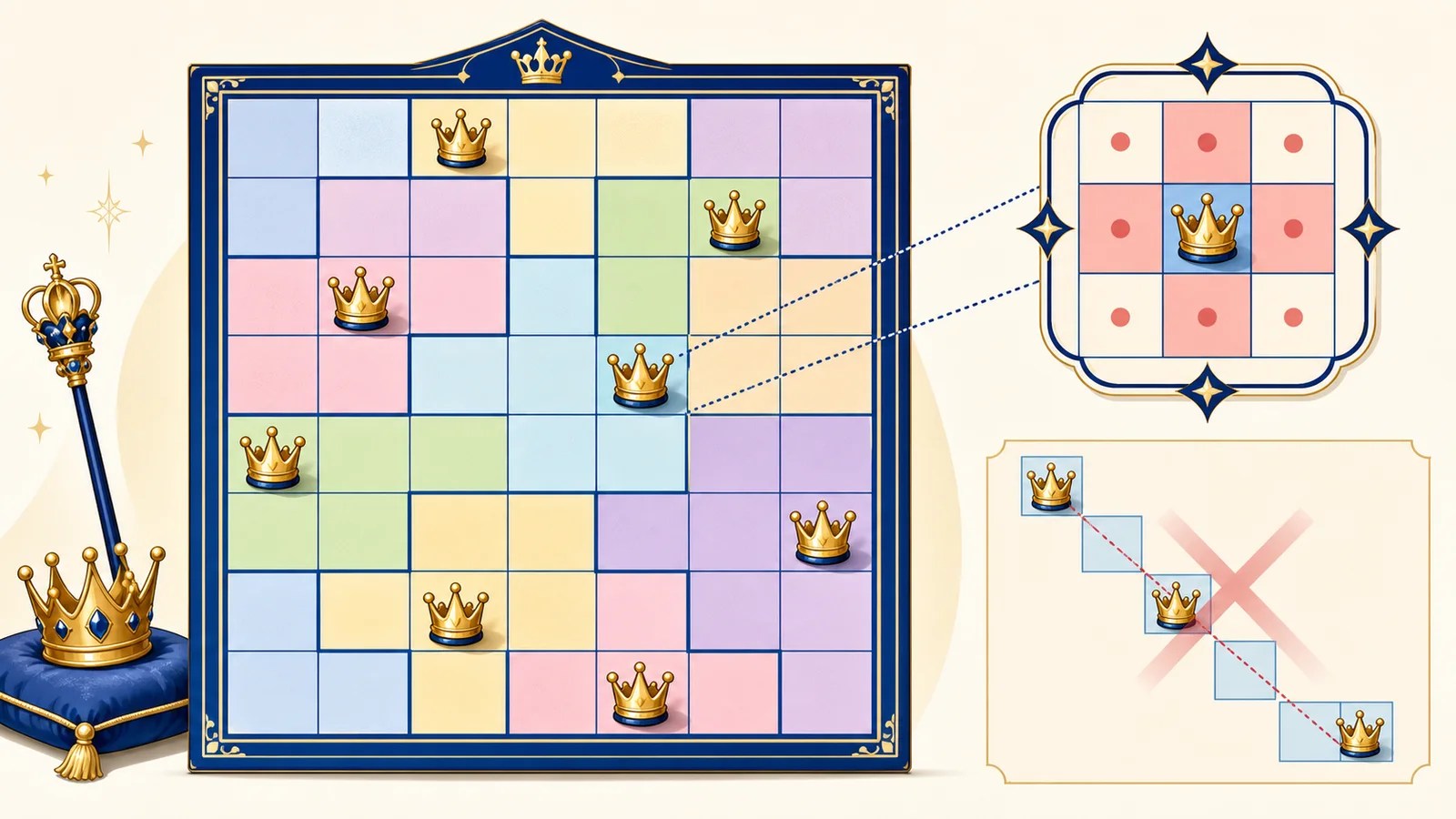
A precise guide to modern Queens Game rules, including rows, columns, color regions, no-touch placement, and the key difference from N-Queens.
Queens Game is a queen-placement logic puzzle played on a grid divided into colored regions. The goal is simple to state: place queens so every row, every column, and every colored region has exactly one queen, while no two queens touch.
The rules are short, but they are easy to mix up with chess or the classic N-Queens problem. This article explains the modern Queens Game rule set precisely so you can solve boards with the right mental model.
Rules at a Glance
| Rule | What it means | Common mistake |
|---|---|---|
| One queen per row | Every horizontal line must contain exactly one queen. | Leaving extra candidates in a row after placing its queen. |
| One queen per column | Every vertical line must contain exactly one queen. | Checking rows carefully but forgetting columns. |
| One queen per colored region | Each color area must contain exactly one queen, no matter its shape. | Treating color regions as visual decoration. |
| No touching queens | Queens cannot sit in neighboring cells that share a side or corner. | Applying full chess diagonal attacks instead of local adjacency. |
The Row Rule
Each row needs exactly one queen. Once a row has a queen, every other cell in that row is ruled out. If a row has only one legal cell left, that cell is forced.
The row rule is simple by itself. The useful deductions happen when it combines with regions. For example, if every remaining cell of a blue region lies in row 4, then row 4 is reserved for blue. Other regions cannot use row 4 for their queens.
The Column Rule
Each column also needs exactly one queen. A confirmed queen clears the rest of its column, and a column with only one legal cell left creates a forced placement.
Rows and columns are symmetrical, but players often scan rows more naturally than columns. A good habit is to rotate your attention: rows, columns, regions, then back again. If the board feels stuck, the missed deduction is often vertical.
The Color Region Rule
Every colored region needs exactly one queen. Region shape is what makes Queens Game feel different from plain row-and-column placement. A region can bend, stretch, or occupy a narrow strip, and that shape can create deductions before any queen is placed.
A small region with only one legal cell is solved. A region whose legal cells all share one row or one column creates a line lock. A group of two regions trapped inside the same two rows can reserve both rows, excluding candidates from other regions. This is why color regions are the heart of the puzzle rather than a cosmetic layer.
What Counts as Touching?
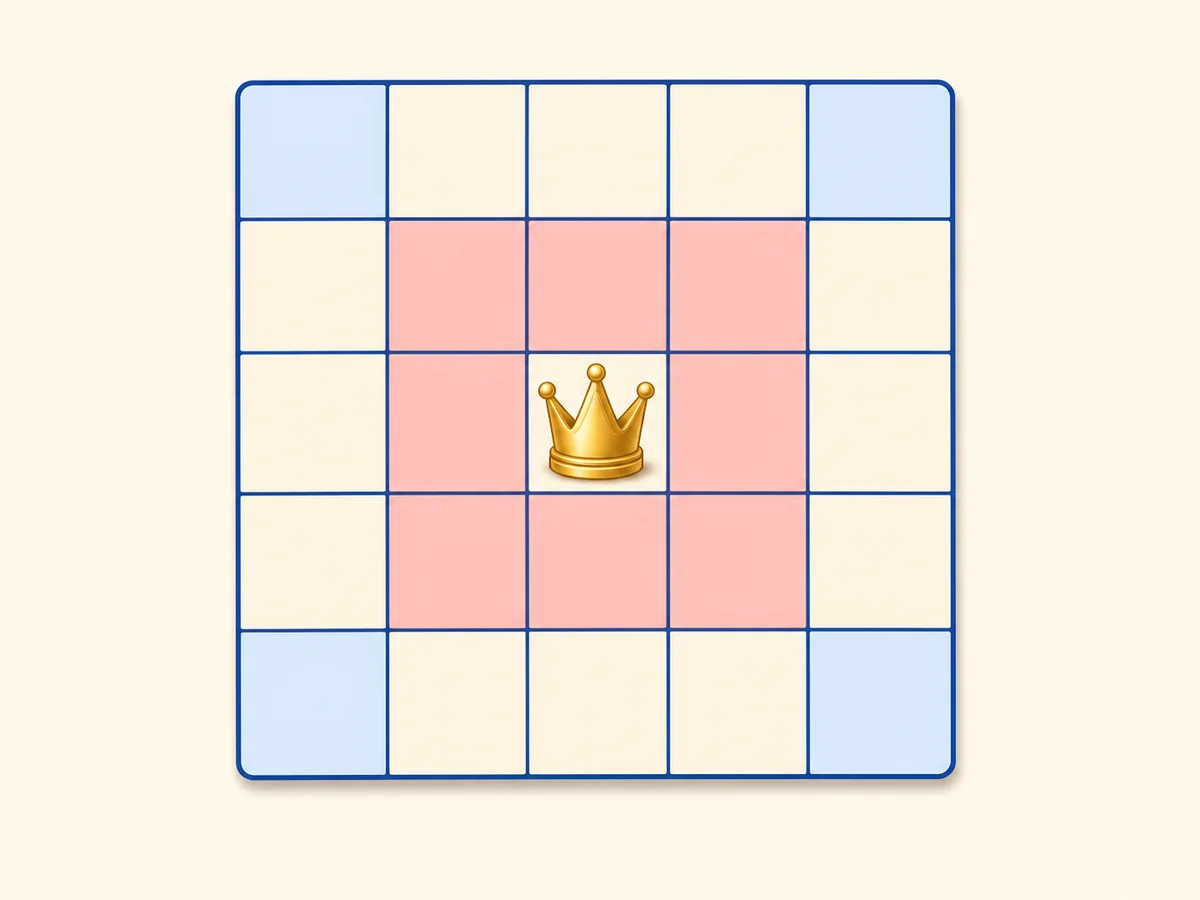
Touching means local adjacency. Two queens are illegal if their cells share an edge. They are also illegal if their cells touch at a corner.
So a queen blocks up to eight neighboring cells: above, below, left, right, and the four diagonal neighbors. On an edge or corner of the board, it blocks fewer cells because fewer neighbors exist.
What it does not block is an entire diagonal line. If a queen is at row 2, column 2, another queen at row 5, column 5 is not automatically illegal in modern Queens Game. It only becomes illegal if another rule rejects it: same row, same column, same region, or adjacent touching.
Modern Queens vs Classic N-Queens
The classic N-Queens problem asks you to place queens on a chessboard so that no two queens attack each other. That means no shared row, no shared column, and no shared diagonal across the entire board.
Modern Queens Game keeps the row and column constraints, adds colored regions, and replaces full diagonal attacks with a local no-touch rule. That difference matters. If you bring the N-Queens diagonal rule into this game, you will mark legal cells as impossible and may convince yourself a valid board is unsolvable.
| Feature | Modern Queens Game | Classic N-Queens |
|---|---|---|
| Rows | Exactly one queen per row | Usually one queen per row |
| Columns | Exactly one queen per column | Usually one queen per column |
| Regions | Exactly one queen per colored region | No colored regions |
| Diagonals | Only adjacent diagonal touching is banned | Full shared diagonals are banned |
Examples of Invalid Placements
- Two queens in the same row: invalid, even if they are far apart and in different regions.
- Two queens in the same column: invalid, even if no queens touch.
- Two queens in one colored region: invalid, even if that region is large.
- Two queens side by side: invalid because they touch horizontally.
- Two queens stacked vertically in neighboring cells: invalid because they touch vertically and share a column.
- Two queens on diagonal neighboring cells: invalid because they touch at a corner.
- Two queens far apart on the same diagonal: not invalid by the diagonal rule alone. Check the row, column, and region rules instead.
Are Solutions Always Unique?
Uniqueness is a property of a puzzle set, not one of the universal rules. A well-designed level may be intended to have one solution, but the rules themselves do not guarantee that every Queens puzzle published anywhere has a unique answer. The safe way to explain the game is to teach the constraints, not to promise uniqueness as a rule.
FAQ
Does a queen attack like a chess queen?
No. The queen icon is thematic. In modern Queens Game, the queen does not attack across the board. It only creates row, column, region, and local touching constraints.
Are diagonal neighbors allowed?
No. Queens cannot touch corner-to-corner. Diagonal adjacency is illegal.
Are long diagonals allowed?
Yes. Queens can share a long diagonal if they are not adjacent and no row, column, or region rule is broken.
Why do colored regions matter so much?
Regions add a third placement requirement on top of rows and columns. Their shapes create line locks, forced cells, and many of the deductions that make the puzzle logical.
What is the fastest way to check a move?
Ask four questions in order: Does the row already have a queen? Does the column already have a queen? Does the region already have a queen? Would this queen touch another queen?
Related Guides
How to Play Queens Game
Learn the modern Queens Game rules, avoid the diagonal-rule trap, and solve your first board with a simple beginner workflow.
Beginner Tips for Queens Logic Puzzles
Practical Queens puzzle strategies for solving more boards with elimination, forced cells, line locks, and careful contradiction checks.