Beginner Queens Game Strategy
Adjacency Elimination
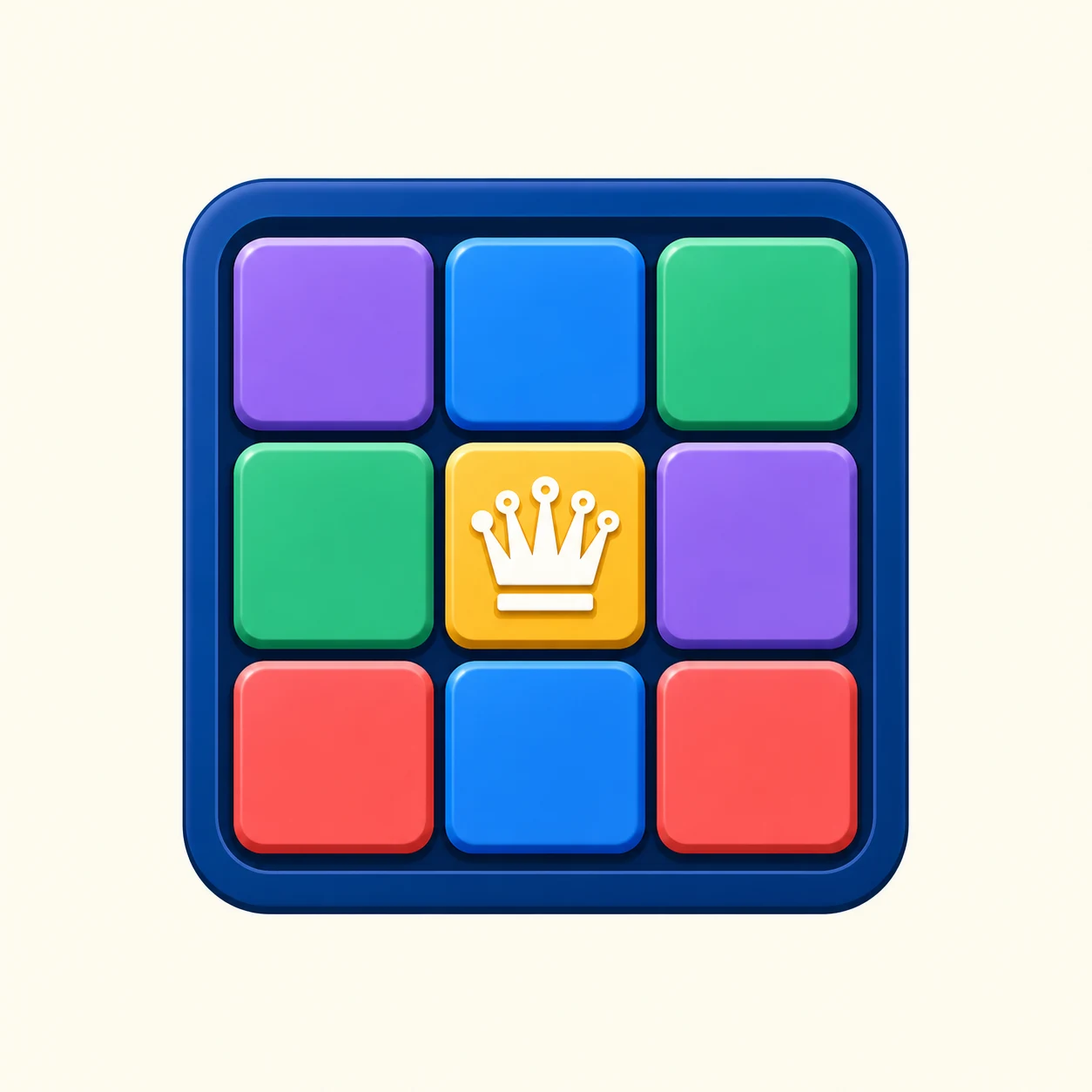
A placed queen blocks all eight neighboring cells, including diagonal neighbors.
Core concept
What it means
Queens in this puzzle do not attack full chess diagonals, but they cannot touch. A confirmed queen rules out neighboring cells above, below, left, right, and diagonally. This local cleanup is one of the fastest ways to create new forced moves.
The important part is that this is not a guess. A good Queens Game move should explain why at least one cell is forced or impossible. Adjacency Elimination gives you that explanation by connecting the four rules of the puzzle: one queen per row, one queen per column, one queen per color region, and no touching queens.
Use this technique slowly at first. Name the container or region you are studying, list the legal candidates, and only then place a queen or mark an X. That habit keeps the board readable when later levels become larger and several deductions interact at once.
Pattern triggers
When to use it
Look for Adjacency Elimination after each confirmed queen and after every round of X marks. The technique is most useful when the board has already been cleaned enough that a row, column, or region has only a few meaningful choices left.
- Corner queens that block fewer cells but still affect diagonals.
- Two-cell region candidates that both crowd the same outside cell.
- Dense 2x2 areas where at most one queen can ever survive.
Solving routine
Step-by-step method
Work through the steps in order. If one step does not prove anything, stop and move to another row, column, or region. The goal is to find a short proof, not to force a move because the board feels stuck.
- 1
After placing a queen, inspect the eight surrounding cells.
- 2
Mark every empty neighbor with X unless it is outside the board.
- 3
Then clear the rest of the queen's row, column, and color region.
- 4
Rescan nearby regions because adjacency often removes their last alternatives.
Worked example
How it appears on a real board
If a queen lands in the center of a 3x3 area, the eight surrounding cells are immediately impossible. Cells farther away on the same diagonal are not blocked by adjacency, so they remain legal unless a row, column, or region rule removes them.
After making the deduction, immediately rescan the board. A single correct mark often creates a cleaner row, a smaller region, or a new no-touch elimination. That chain reaction is where Queens Game starts to feel logical instead of random.
Accuracy checks
Common mistakes
Most errors come from counting cells too quickly. Before you mark a cell, check whether the candidate is illegal because of the row, the column, the region, or adjacency. If you cannot name the reason, leave the cell open.
- Applying full chess diagonal attacks across the board.
- Skipping diagonal neighbors because they only touch by a corner.
- Cleaning the row and column but not the local no-touch cells.
Practice checklist
Use it on your next board
Place a test queen on paper and mark only its touching cells. Keep long diagonal cells open unless another rule blocks them.
- Choose one row, column, or region and name every legal candidate.
- Remove candidates only when a rule explains the removal.
- After a placement, clean the row, column, region, and touching cells before looking elsewhere.
- Write down the next forced move in words before you click the board.